Second Act, Full Out: How Adults Are Finding Their Most Authentic Selves Through Dance After 40
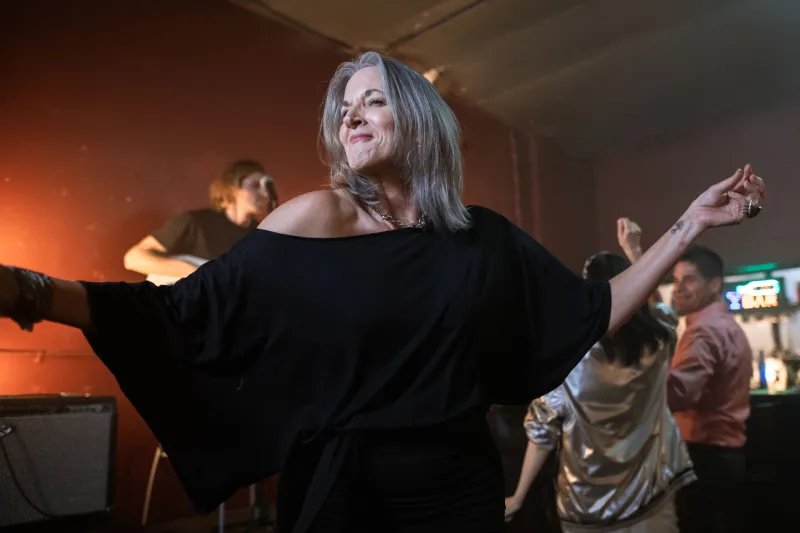
There's a moment that a lot of late-blooming dancers describe almost identically. It usually happens a few weeks into their first adult beginner class — somewhere between fumbling through a basic step and suddenly, inexplicably, getting it. The room disappears. The self-consciousness lifts. And for a few seconds, they feel more like themselves than they have in years.
For some people, that moment arrives at 42. For others, it's 57. Sometimes it's 71.
And increasingly, that moment is becoming a turning point — not just in how people move, but in how they live.
The Reinvention Nobody's Talking About
We love a good second-act story in this country. The executive who becomes a yoga teacher. The empty-nester who goes back to school. But the adults who are using dance as the engine of personal reinvention don't always make the headlines — even though their transformations are some of the most radical happening right now.
Consider the numbers: enrollment in adult beginner dance programs has grown steadily over the past decade, and studios across the US report that their fastest-growing demographic isn't teenagers — it's adults over 40. Community centers, university continuing education programs, and independent dance studios are all seeing the same thing. People who spent decades telling themselves dance wasn't for them are showing up, sometimes shaking, and asking for a spot at the barre.
What's driving it? The reasons are as varied as the people walking through the door. Career burnout. Divorce. The death of a parent. A cancer diagnosis. An empty nest. The pandemic. Sometimes it's just a random YouTube video that lands on a Tuesday night and refuses to leave the brain alone.
But the why matters less than what happens next.
Movement as Metaphor — and Medicine
Dance has always carried a particular kind of transformative power that other fitness modalities don't quite replicate. A spin class will get your heart rate up. A weightlifting program will change your body composition. But dance asks something different of you. It asks you to express something, to coordinate thought and feeling with physical action, to be present in a way that most of our daily lives actively discourage.
For adults navigating major life transitions, that combination turns out to be unusually potent.
Researchers studying the psychological effects of dance on older adults have found consistent evidence of improvements in self-esteem, emotional regulation, and sense of identity. But you don't need a clinical study to understand why. Think about what learning a new dance style actually demands: you have to let go of the idea that you already know how to do this. You have to be a beginner. You have to fail, repeatedly, in front of other people. And then you have to try again.
For someone who spent 25 years in a career that defined their entire sense of worth, that practice of graceful failure is quietly revolutionary.
Stories That Stick
Take the experience of women in their 50s who come to dance after raising children or leaving long marriages — a pattern that studio owners and instructors across the country describe seeing constantly. Many arrive apologizing for their bodies, their age, their lack of coordination. Within months, something fundamentally shifts. The apologies stop. The posture changes. They start taking up space differently — not just on the dance floor, but everywhere.
Or consider the men — and there are more of them than you might think — who discover contemporary dance or even ballroom in their late 40s and describe it as the first time they've ever had a physical relationship with their own emotions. American culture doesn't give men a lot of permission to move expressively. Dance hands them that permission directly, no explanation required.
Then there are the dancers who come specifically for healing. Trauma survivors who find that somatic movement does what years of talk therapy couldn't fully reach. Veterans working through PTSD in programs that use contemporary dance and body-based practices. Adults recovering from strokes or serious injury who rediscover agency in their bodies through structured movement.
In every case, what's happening is bigger than fitness. It's an identity reconstruction project.
What Dance Knows That We Forget
Here's the thing about dance that makes it uniquely suited for reinvention: it holds you accountable to the present moment. You can't dance yesterday's step today. You can't phone it in from your head. The body has to show up, right now, and commit.
For adults who've spent years running from the present — grinding toward future goals, replaying past mistakes, managing a life that accumulated faster than it was designed — that insistence on nowness is both terrifying and liberating.
It's also cumulative. Each class builds on the last. Each new skill — a turn sequence, a partner connection, a piece of choreography memorized and embodied — becomes evidence of capacity. Evidence that the body is still capable of learning. That the self is still capable of growth.
At 50. At 60. At whatever age you finally decide to show up.
You Don't Have to Be Starting Over to Start
One of the most persistent myths about adult dance is that it requires some dramatic life crisis as an entry point. That you need a reason, a rock-bottom moment, a transformation already underway.
You don't.
Some of the most profound reinventions happen quietly, from the inside out, simply because someone decided to try something new. They signed up for a West African dance class because it looked fun. They wandered into a contact improv workshop out of curiosity. They watched their kid's dance recital and thought, I want some of that.
The transformation follows the movement. Not the other way around.
If there's a through-line in every story of adult dancers who credit dance with changing their lives, it's this: they didn't wait until they felt ready. They walked in anyway. And the floor met them where they were.
That's the invitation. It doesn't expire.
And it's definitely not too late.