How Two Generations Learned to Move: The Cultural Gap Between Gen Z and Millennial Dance
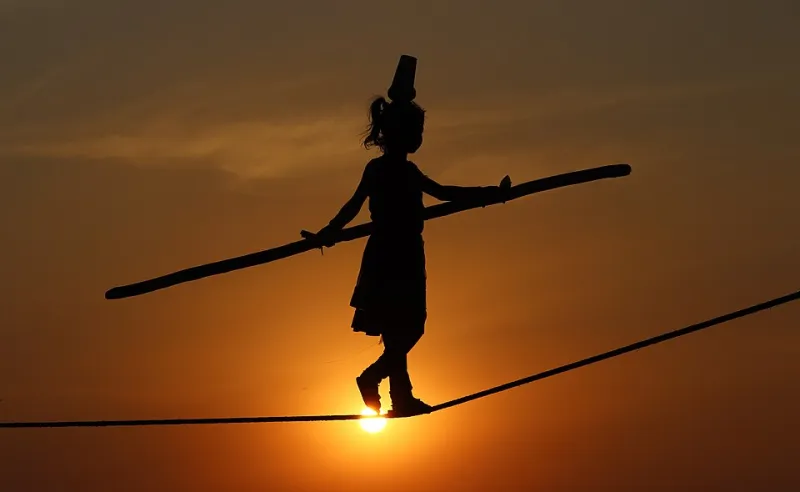
Photo: Derivative work: IamMM, Original: Manir Dhabak, CC BY-SA 4.0, via Wikimedia Commons
Put a 24-year-old and a 38-year-old in the same freestyle circle and watch what happens. The differences are immediate and a little hard to articulate. Something about energy direction, about relationship to the camera that may or may not be in the room, about the willingness to go small versus big, to be weird versus clean.
This isn't just personal style. It's generational vocabulary — and the story of how it got that way is more interesting than a simple "kids these days" take.
Two Different Schools of Cool
Millennials, broadly speaking, grew up learning to dance from music videos, movies, and in-person classes. The reference points were aspirational and often hierarchical — you watched Usher, you watched Step Up, you watched the best person in the room and tried to approximate what they were doing. Technique and showmanship were the currencies. You performed for an audience, even if that audience was just the mirror.
The feedback loop was slow. You practiced, you showed people at a party or in a talent show, you got a reaction. The gap between learning and performing was wide.
Gen Z grew up inside a completely different system. TikTok, Instagram Reels, and YouTube Shorts compressed that gap to almost nothing. You learn a move, you film yourself doing it, you post it, you get feedback in minutes. The audience is always present, even when you're alone in your bedroom. And critically — the audience is also the teacher. Trends don't come down from on high; they bubble up from anywhere and spread laterally.
"Millennials learned from gatekeepers," says choreographer and movement educator Priya Nair, who teaches workshops across age groups in Los Angeles. "Gen Z learned from each other. That changes everything about how you relate to your own body and to other dancers."
The Algorithm Is a Choreographer
This point deserves more attention than it usually gets. TikTok's recommendation algorithm doesn't just distribute dance content — it actively shapes what gets made.
Because the platform rewards short, loopable, visually immediate content, the movement vocabulary that thrives on it tends to be compact, detail-oriented, and optimized for a static frame. Arms and upper body read well on camera. Big traveling combinations don't. Intricate finger tutting, subtle isolations, facial expression — these translate. Grand allegro does not.
The result is a generation of dancers who are extraordinarily precise in their upper bodies and deeply attuned to what reads on a 6-inch screen. That's not a criticism — it's an adaptation. The medium shaped the movement, the way it always has. MTV shaped how Millennials thought about performance. TikTok is doing the same thing now, just faster and with more direct feedback.
"I have students who are genuinely brilliant at camera-facing choreography," says Marcus Delgado, a hip-hop instructor in New York City. "Put them in a cypher, though — a real live circle — and some of them freeze. The performance context is so different. They're used to infinite takes."
Gender, Fluidity, and the Body
One of the most striking differences between generational movement cultures is how Gen Z dancers relate to gender in choreography.
For much of recent American dance history — including the era when Millennials were coming up — choreography was heavily gendered. Male dancers did certain things; female dancers did others. Styles associated with femininity (ballet, contemporary, jazz) and styles associated with masculinity (breakdancing, krump, certain hip-hop styles) were largely siloed, and crossing those lines required a degree of social negotiation.
Gen Z has largely stopped asking for permission to cross those lines.
Fluid movement vocabulary — combining styles, playing with traditionally feminine or masculine gestures without irony or explanation — is increasingly the norm in Gen Z dance spaces. Heels choreography, once a niche performance art form, has exploded in popularity across gender identities. Male-presenting dancers incorporating lyrical, expressive movement face far less social friction than they did ten or fifteen years ago.
"My students don't think of styles as gendered," Priya says. "They think of them as options. That's a genuinely new thing, and it's exciting."
The Appropriation Conversation Is Different Now
One area where generational friction is real and sometimes heated: how each cohort thinks about cultural appropriation in dance.
Millennials came of age during a period when the appropriation conversation was becoming more prominent but was still relatively new in mainstream discourse. Many Millennial dancers absorbed styles across cultural lines without a strong framework for thinking about lineage, credit, or accountability.
Gen Z dancers — particularly those active on social media — operate in a much more explicit conversation about these questions. Who originated a style? Who's getting paid and credited for it? When does appreciation become extraction? These aren't abstract questions for many Gen Z dancers; they're part of the daily texture of online dance culture.
This doesn't mean Gen Z has it all figured out — the conversation is messy and ongoing, and social media can turn nuanced questions into pile-ons. But the baseline expectation of accountability is higher, and that's shifting how choreographers of all ages think about sourcing their movement.
What Each Generation Can Learn From the Other
Here's the thing about generational divides in dance: they're most interesting as invitations.
Millennial dancers have things to offer — a relationship to live performance, to full-body spatial awareness, to the experience of dancing without a camera present — that translate poorly to a screen but matter enormously on a floor. The embodied confidence that comes from years of performing for real humans in real rooms is its own kind of intelligence.
Gen Z dancers bring something different: an extraordinary sensitivity to detail, a willingness to experiment with identity and style, and a comfort with visibility and feedback that many older dancers find genuinely challenging to cultivate.
The most interesting choreography happening right now, arguably, sits at the intersection — work that's visually precise and platform-savvy but also spatially alive, emotionally present, and rooted in a real lineage.
Watch for it. Better yet, make it.